Press Room
US Financial Services Firms Lose $5.47 for Every $1 of Fraud as AI-Assisted Attacks Shift to Digital and Mobile Channels
10/19/2026
ATLANTA & LAS VEGAS — LexisNexis® Risk Solutions today announced at Money20/20 USA findings from its LexisNexis® True Cost of Fraud™ Study 2026 North America: Financial Services and Lending.
Every $1 of fraud now costs US financial services firms $5.47, up from $4.00 in 2021. US lending firms incur $4.84, while financial services and lending firms in Canada incur $4.09 and $3.89, respectively. Organizations estimate AI generated techniques contribute to about one fifth of fraud losses.
Digital channels are the most targeted. Websites and mobile apps account for 69% of all fraud losses, and 96% of institutions report an increase in fraud targeting mobile apps.
The report also finds that fraud costs extend beyond financial losses. Organizations reported significant effects on customer trust (49%), compliance workload (47%) and brand reputation (39%). More than half (56%) said fraud prevention strategies increased customer churn, underscoring the challenge of protecting customers without adding unnecessary friction.
“Fraud continues to evolve across every stage of the customer journey, and digital channels and AI-assisted techniques are increasing the speed, scale and complexity of attacks,” said Kimberly White, senior director, fraud and identity, North America, LexisNexis® Risk Solutions. “The findings show that financial institutions with more automated and integrated fraud prevention programs report stronger effectiveness, better performance and greater reductions in customer churn. A layered strategy that connects identity intelligence, behavioral insights, device intelligence and AI-driven decisioning can help organizations respond to changing threats while supporting trusted customer experiences and sustainable growth.”
The total cost of fraud keeps climbing across North America
The LexisNexis Fraud Multiplier™ metric tracks the total cost of every $1 of fraud, including fees, interest, replacement costs, customer acquisition and crisis management. Since 2021 it has risen for every North American segment except lending services in Canada:
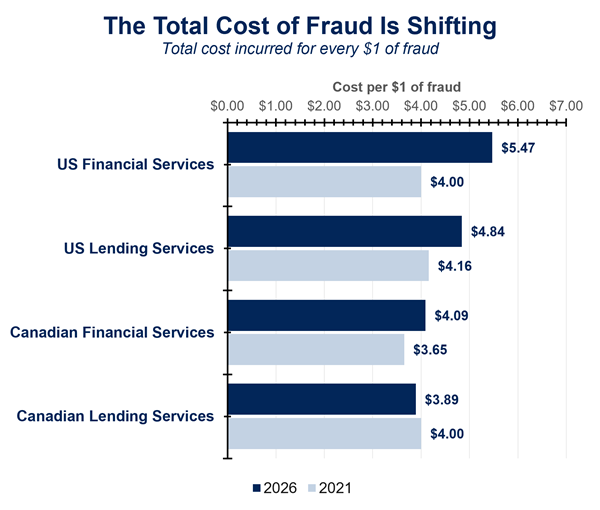
Fig. 1 – A 2026 vs. 2021 comparison of True Cost of Fraud™: LexisNexis Fraud Multiplier™ data
US financial services and lending firms incur roughly $1 more than their Canadian counterparts for every $1 of fraud loss. The pattern echoes the company’s True Cost of Fraud™ 2026 Study for Retail and Ecommerce in North America, where the multiplier crossed $5 in both markets for the first time. About 48% of losses are recovery and reimbursement costs and direct liabilities such as chargebacks. The remaining 52% includes fees and interest, customer acquisition and crisis communications.
AI is reshaping both fraud attacks and financial institution defenses
Organizations estimate that fraudsters use AI-generated techniques in 19% of fraud losses in the US and 25% in Canada. Financial institutions are also increasing their use of AI in response. More than half (56%) use AI to help defend against synthetic identity fraud and account takeover, while 48% use it to combat scams and 46% use it to address first-party fraud. Four in five respondents consider AI powered capabilities extremely or very important when selecting fraud prevention solutions, and 35% expect advanced AI and machine learning analytics to have the greatest impact on fraud prevention over the next one to two years.
Digital and mobile channels dominate fraud losses
Websites account for 39% of fraud losses, while mobile apps account for 30%. Nearly all institutions (96%) said fraud targeting mobile apps rose over the past year, and 69% reported mobile fraud costs increased by 10% or more. Attacks were concentrated in transaction activity (39%), new account creation (33%) and account login or access (28%). Card transactions (26%) and account transfers (22%) together accounted for 48% of fraud losses.
Scams, bots and identity attacks add to the pressure
Financial institutions attribute roughly one third of their fraud losses to scams. US firms reimburse 31.2% of scam losses, compared with 38.9% in Canada. Malicious bot attacks, which test stolen credentials and target logins, represent 14% of monthly transactions in the US and 21.8% in Canada. Most firms reported an increase in bot volume over the past year. Identity verification remains a significant challenge, with synthetic identity fraud the largest loss category at 19%. Third-party identity fraud, third-party account takeover fraud and first-party fraud each account for 17%.
Automated fraud programs lead to better outcomes
The study found a clear performance gap between organizations with mainly automated fraud prevention programs and those relying mainly on manual processes.
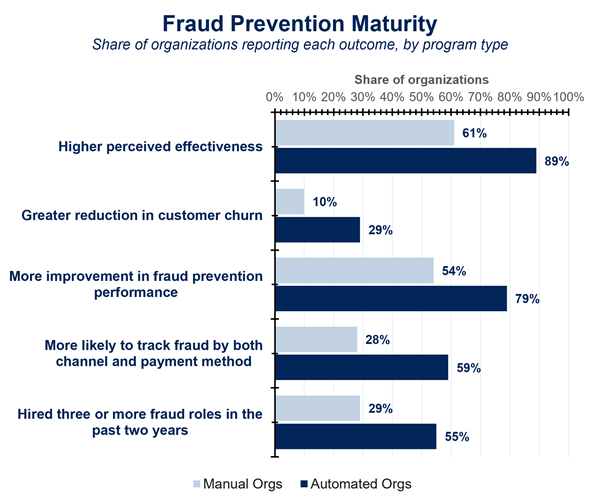
Fig. 2 – Organizations using more automated fraud programs consistently outperform more manual organizations
Organizations with mainly automated programs reported higher perceived effectiveness (89% compared with 61%), greater reductions in customer churn (29% compared with 10%) and more improvement in fraud prevention performance (79% compared with 54%). They were also more likely to track fraud by both channel and payment method (59% compared with 28%) and to have hired three or more fraud roles in the past two years (55% compared with 29%
Fraud prevention spending is expected to increase, but implementation challenges are slowing AI adoption
Over the next 24 months, financial institutions plan to prioritize investment in biometric authentication (53%), verifiable credentials and digital identity wallets (48%), behavioral intelligence (47%) and digital risk assessment (45%). Nearly two thirds (62%) plan to invest in AI enhanced identity verification, though limited internal expertise, integration complexity and data quality challenges are slowing adoption.
About the LexisNexis True Cost of Fraud Study 2026 North America
The study examines fraud trends, costs, prevention priorities, technology adoption and reported business outcomes among financial services and lending organizations in the US and Canada.
Download the LexisNexis® True Cost of Fraud™ Study.
About LexisNexis Risk Solutions
LexisNexis® Risk Solutions provides customers with information-based analytics and decision tools that combine public and industry-specific content with advanced technology and algorithms to assist them in evaluating and predicting risk and enhancing operational efficiency. Headquartered in metro Atlanta, Georgia, the company has offices throughout the world, serves customers in more than 190 countries and territories and is part of RELX. For more information, please visit LexisNexis Risk Solutions and RELX.
Media Contacts
Senior Manager, Communications, North America & Latin America
[email protected]
+1.754.249.6480